A new opportunity in the US
$204K a year with a one-man mobile body repair business.
We help entrepreneurs start a mobile body repair business in the US — beginning with one van and building toward the potential to scale into the millions.
$204K is an illustrative one-operator revenue example, not a guarantee or profit figure.
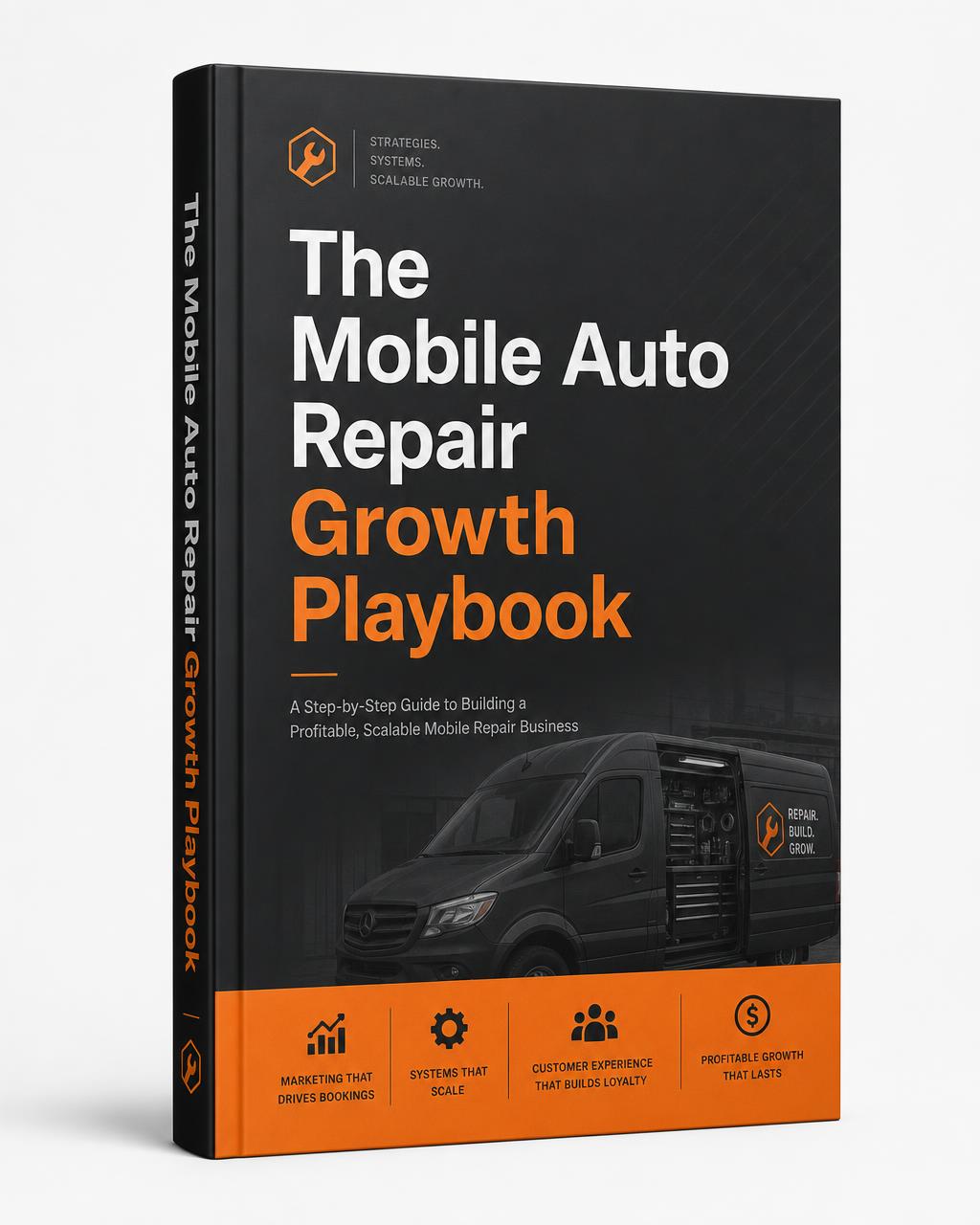
$47 one-time payment
25
action-packed pages
15
practical chapters
30
day launch plan
- US terminology and market context
- Startup equipment and van planning
- Pricing and average-ticket logic
- 30-day launch plan
- Customer and B2B outreach scripts
Photo-qualified jobs
Learn how to screen damage before driving.
Route-based economics
Build around minimum charges, ticket size, and travel time.
Measured growth
Use real operating data before hiring or expanding.
The real starting problem
The hard part is not finding a van. It is building a business around the van.
Beginners usually need answers to four practical questions: What work should I offer? What work should I refuse? What should I charge after time, travel, materials, and rework? And how do I turn local demand into repeatable route days?
Unclear scope
Avoid taking structural, sensor-related, unsafe, or technically unsuitable work.
Unclear economics
Understand average ticket, production capacity, materials, travel, payment fees, rework, overhead, and owner labor.
Unclear setup
Know what tools, storage, power, PPE, training, documentation, and insurance questions come first.
Unclear customer system
Build a mix of local search, proof, reviews, dealerships, fleets, body shops, auctions, and detailer partnerships.
A rare US opportunity
Most people don't know this business exists — that's the opening
Mobile cosmetic auto repair brings smaller appearance fixes straight to the customer: eligible dents, door dings, paintless dent repair, selected bumper cosmetics, and minor scratch or touch-up work. It's a low-competition local service you can start from one van — no shop rent, no full collision-shop overhead, and no need to be the biggest operator in town to win.
Start narrow
Choose a service model that you can train, insure, and repeat.
Serve where the customer is
Homes, workplaces, dealer lots, fleets, auctions, body shops, and other permitted locations.
Protect the route
Use photo qualification, a core zone, minimum charges, and travel rules.
Scale with systems
Add technicians only after demand, contribution, quality, and compliance are stable.
“SMART repair” is useful operator language, but it should not be the only phrase you use—many US customers search for mobile dent repair, PDR, bumper repair, or scratch repair instead.
Business math
See the business math before you spend on equipment
The guide shows how to build a bottom-up model from completed jobs, average ticket, production days, materials, mileage, payment costs, rework, owner labor, and fixed overhead. It does not present a national average or promise that every buyer will reach a particular result.
Illustrative scenario · one operator
- Completed jobs per day
- 2
- Modeled average ticket
- $425
- Production days
- 240
- Illustrative gross revenue
- $204,000
2 jobs/day × $425 average ticket × 240 production days = $204,000 gross revenue
Revenue is not profit. The scenario excludes or separately models materials, mileage, insurance, taxes, equipment, downtime, callbacks, owner labor, debt, and other overhead.
Illustrative capacity · scaled team
- Producing technicians
- 5
- Modeled jobs per technician
- 480
- Modeled average ticket
- $425
- Illustrative revenue capacity
- $1,020,000
5 technicians × 480 jobs × $425 average ticket = $1,020,000 revenue capacity
Capacity math only. It assumes demand, trained technicians, route density, acceptable rework, management, and centralized support.
The guide includes illustrative revenue scenarios. Results vary by location, skill, service mix, pricing, route density, demand, marketing, execution, capital, operating costs, and legal requirements.
$47 one-time payment · Instant digital download · No subscription
Guide preview
Inside the Mobile Auto Repair Growth Playbook
Fifteen practical chapters that move from opportunity and terminology to launch, operations, marketing, and measured scaling.
- 01The US mobile cosmetic auto-repair opportunity
- 02The customer language: PDR, dent, bumper, scratch, and touch-up
- 03Choosing the first service model and risk boundary
- 04Local territory validation before buying the van
- 05Business setup, insurance, compliance, and site requirements
- 06Equipment, suppliers, storage, power, PPE, and van fit-out
- 07Lean, standard, and premium startup budgets
- 08Training progression and referral rules
- 09Service menu, visual triage, quoting, deposits, and minimum charges
- 10Average-ticket logic, contribution, break-even, and route density
- 11The one-person $200K scenario and a measured team-scaling path
- 12SOPs, quality, warranty, rework, and job records
- 13Google Business Profile, content, reviews, paid lead testing, and partnerships
- 1430-day launch plan, 90-day decision gate, and KPI dashboard
- 15Templates, scripts, checklists, FAQ, and source map
What's included
One practical playbook. Ten launch assets. $47 today.
| Included asset | Stated value |
|---|---|
| Market and US terminology map | $79 |
| Compliance and risk-boundary checklist | $149 |
| Equipment and van buying list | $99 |
| Lean, standard, and premium startup budgets | $79 |
| Service-menu and quoting framework | $99 |
| Unit-economics calculator logic | $129 |
| SOP and quality-control system | $99 |
| Lead-generation and partnership playbook | $99 |
| 30-day and 90-day launch plans | $79 |
| Templates, scripts, KPI dashboard, and FAQ | $86 |
| Up to $997 in included planning value | $47 today |
Stated value is an allocation of the included materials' planning value. It is not a guarantee of earnings, leads, profit, return on investment, or business success.
$47 one-time payment · Instant digital download · No subscription
See the real product
Not a teaser. A complete operating playbook.
These are actual pages from the guide you receive immediately after purchase. The layouts make the numbers, checklists, and launch actions easy to work through.
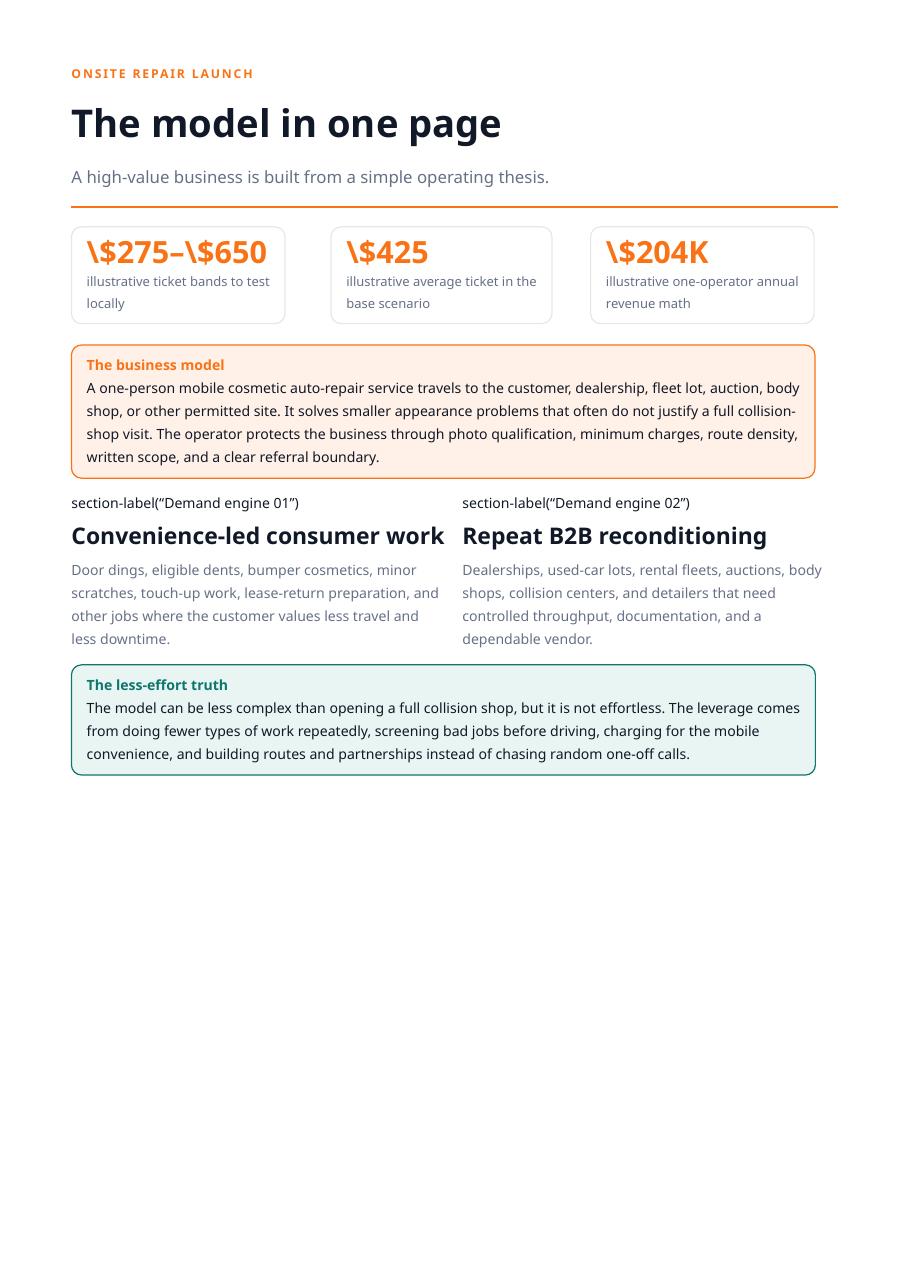
The business model
See the ticket assumptions and one-operator model at a glance.
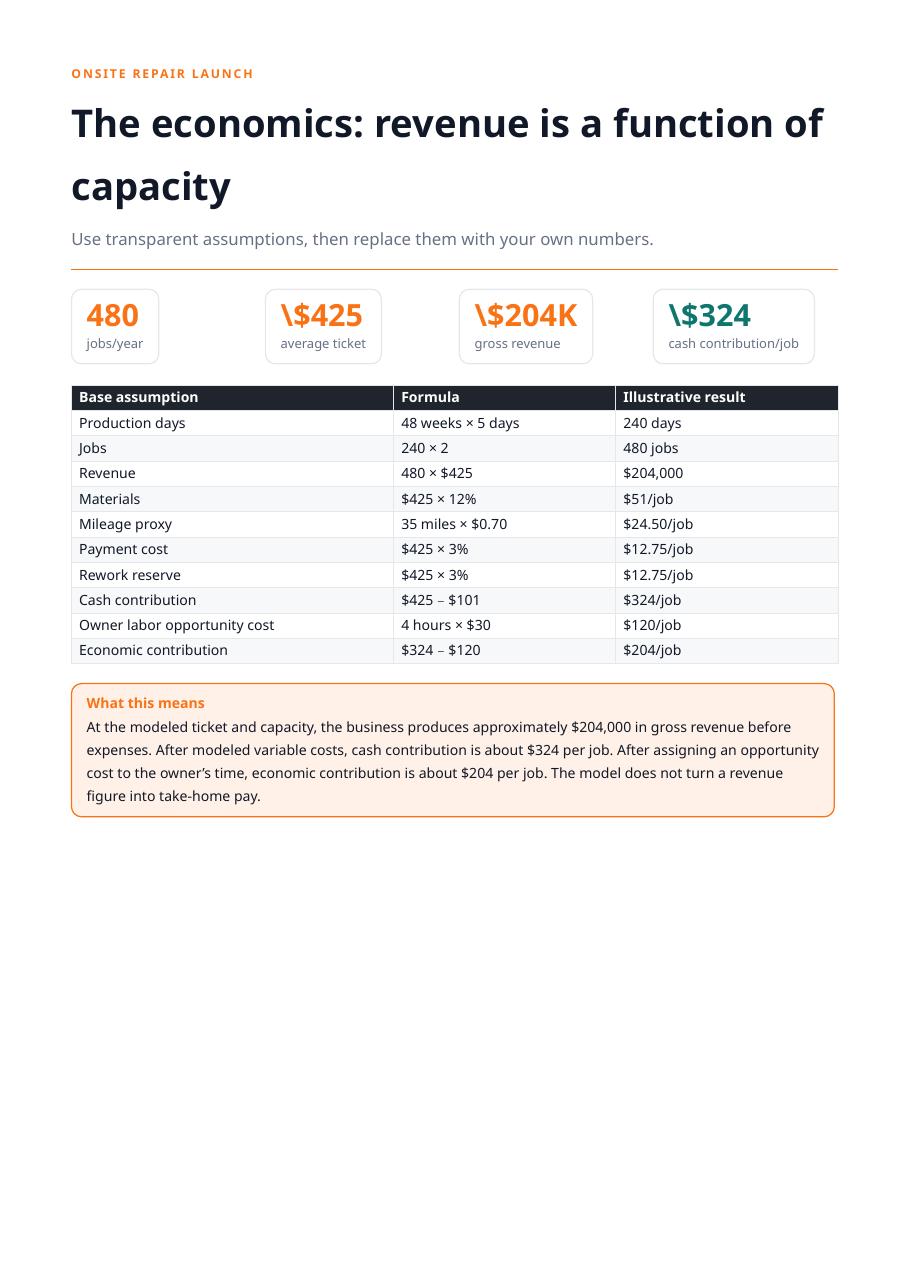
Revenue economics
Work through capacity, route density, costs, and break-even.
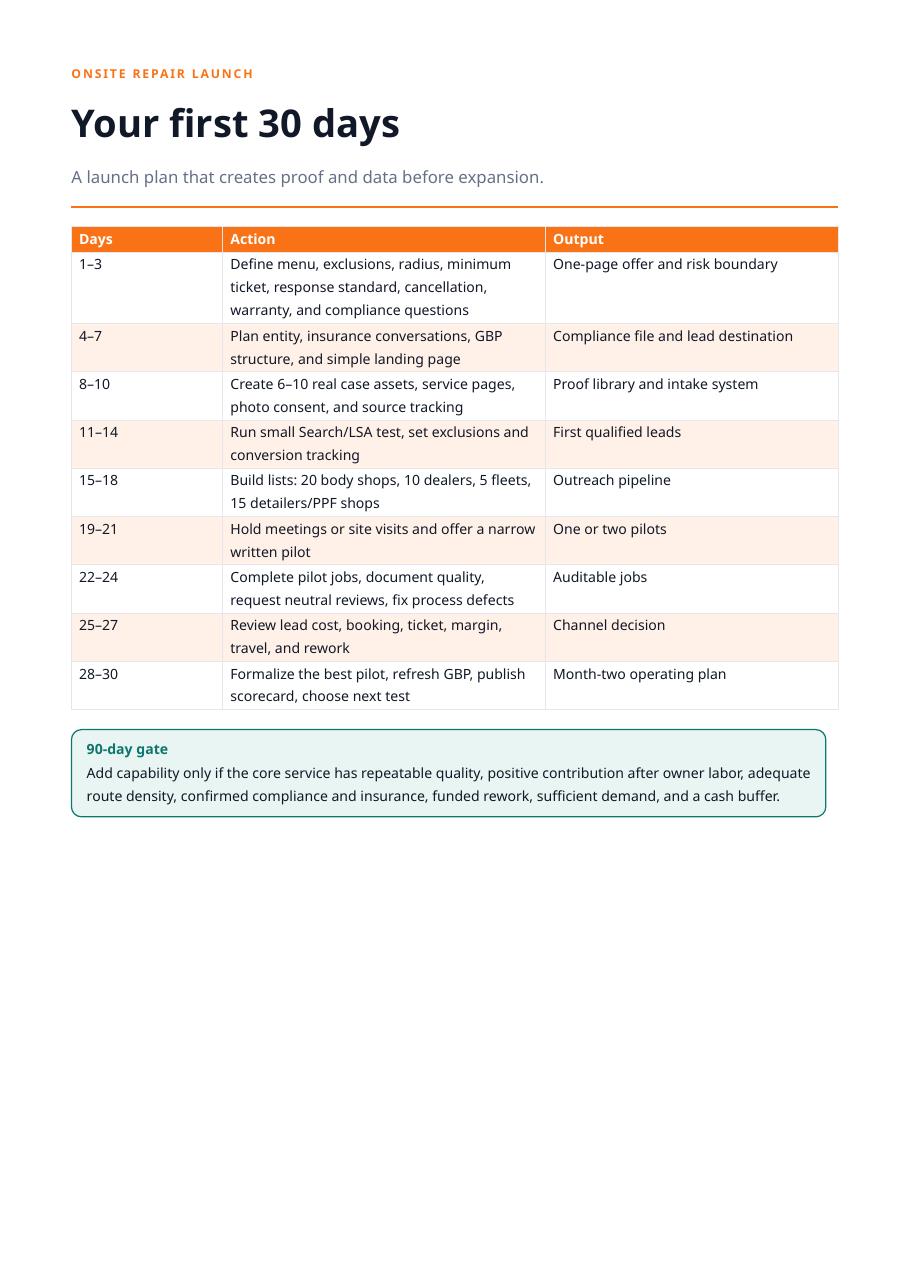
Your first 30 days
Follow a focused launch sequence built around proof and real data.
Secure checkout
Protected card payment
Immediate access
Read online after purchase
Built for action
Checklists, scripts, and math
$47 one-time payment · Instant digital download · No subscription
Buyer fit
This is for practical builders—not shortcut seekers
Good fit
- Willing to learn the technical work or work with a qualified technician.
- Wants a local mobile service model.
- Willing to define and respect exclusions.
- Wants more control over schedule and customer relationships.
- Willing to measure local demand and costs.
- Interested in eventually systemizing and hiring.
Not a fit
- Wants guaranteed income or instant customers.
- Plans to spray or repair outside a safe, trained, insured, and permitted scope.
- Expects a guide to replace legal, technical, tax, safety, or insurance professionals.
- Will not track time, miles, materials, rework, and contribution.
How it works
A clearer first 30 days
Choose the model
Decide between PDR-first, hybrid cosmetic, reconditioning route, or partner-facility approach.
Build the plan
Select territory, equipment level, minimum ticket, quote process, compliance questions, and first partnerships.
Test the market
Use photo qualification, real quotes, content, reviews, partner pilots, and a KPI dashboard.
You are not buying hype.
You are buying a clearer starting point: a well-structured guide, scenario math, operating templates, customer-acquisition scripts, and a practical launch sequence.
Payments are processed securely by our payment provider. Card details never touch this website.
Questions
Frequently asked questions
Is this a repair certification?
Do I need prior auto-body experience?
Can I really make $200,000?
What is the average ticket price?
What services should a beginner start with?
Can I spray paint in my van or driveway?
What equipment do I need?
Does the guide include marketing scripts?
Is this a subscription?
What is the refund policy?
Does the guide cover state licensing?
Start with a better plan than “buy a van and hope.”
Get the Mobile Auto Repair Growth Playbook and turn the idea into a measurable launch plan.
$47 one-time payment
Digital educational product. No recurring subscription. No income or business-success guarantee.